How a case moves from charge to sentence
The journey of a criminal case in England and Wales, step by step, with the official time each stage takes.
- 1. Offence and investigationThe police record the crime and investigate. The MoJ measures time from the date of the offence.What “Charge” means →
- 2. Charge or summonsThe police or the CPS charge the suspect, or a written summons is issued.What “Charge” means →
- 3. First hearing in the magistrates’ courtEvery case starts here. Plea, bail or custody, and where the case will be heard.What “First hearing” means →
- 4. Bail or custody (remand)Between hearings the defendant is on bail or held in custody, subject to time limits.What “Remand (bail or custody)” means →
- 5. Which court?Summary cases stay with magistrates. Indictable-only cases go to the Crown Court. Either-way cases are allocated.What “Allocation (which court)” means →
- 6. Sent to the Crown CourtSerious cases move to the Crown Court and join its caseload.What “Sent to the Crown Court” means →
- 7. Plea and trialGuilty plea, or a trial that may be effective, cracked or ineffective.What “Plea (guilty or not guilty)” means →
- 8. Verdict and sentenceIf convicted, the court sentences using Sentencing Council guidelines.What “Sentencing” means →
How long each stage takes
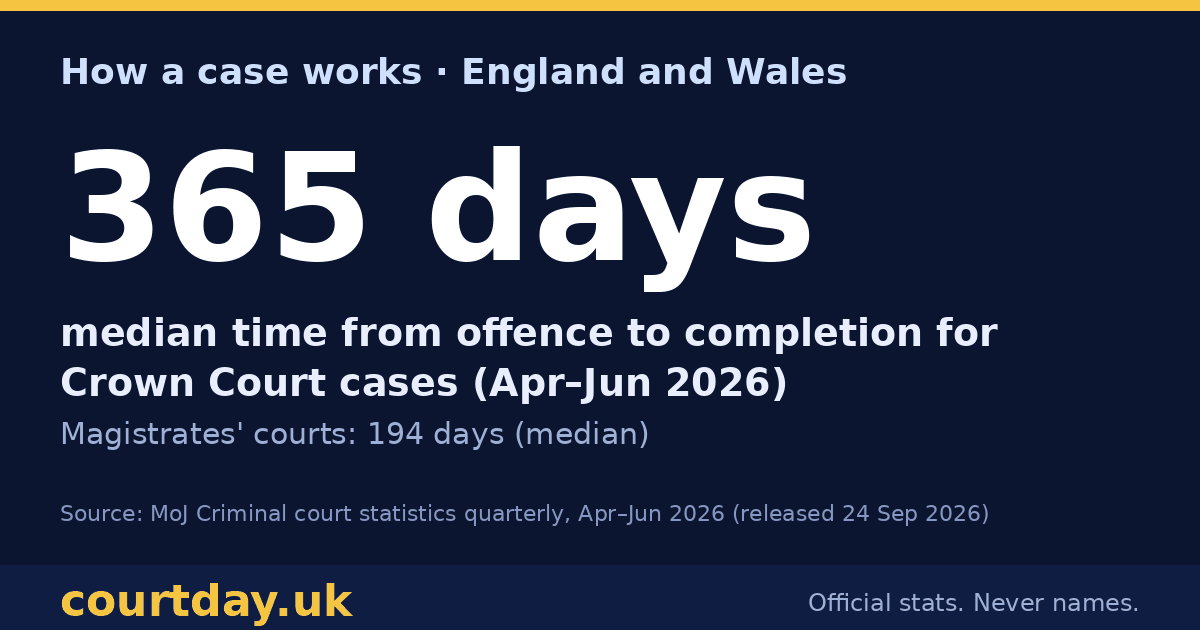
Median days for cases that finished in Apr–Jun 2026. Half of cases took longer. Full timeliness figures →
Tap the chart for a share image ↗ · figures in the table below
| Stage | Crown Court cases | All magistrates' cases* |
|---|---|---|
| Offence to charge | 88 | 141 |
| Charge to first hearing | 1 | 38 |
| Sent to Crown Court to main hearing | 100 | – |
| Main hearing to completion | 25 | – |
| Offence to completion | 365 | 194 |
Source: MoJ Criminal court statistics quarterly, Apr–Jun 2026 (released 24 Sep 2026) · Tables T2 and T4. *Includes cases later sent to the Crown Court; magistrates’ completion = when finished there or sent up.
Plain-English summary, not legal advice. See the explainers for official definitions.